
Is Your Christmas House Making the Static Mistake?
If You Spent Last December on a Ladder Just to End Up With the Same House as Everyone Else on the Block, There's a Reason Nobody Looked Up
A nine-year-old who stopped running to the window, a neighbor's porch that made cars slow down, and a quirk of the human eye that explains why most Christmas lights disappear by December 10th.
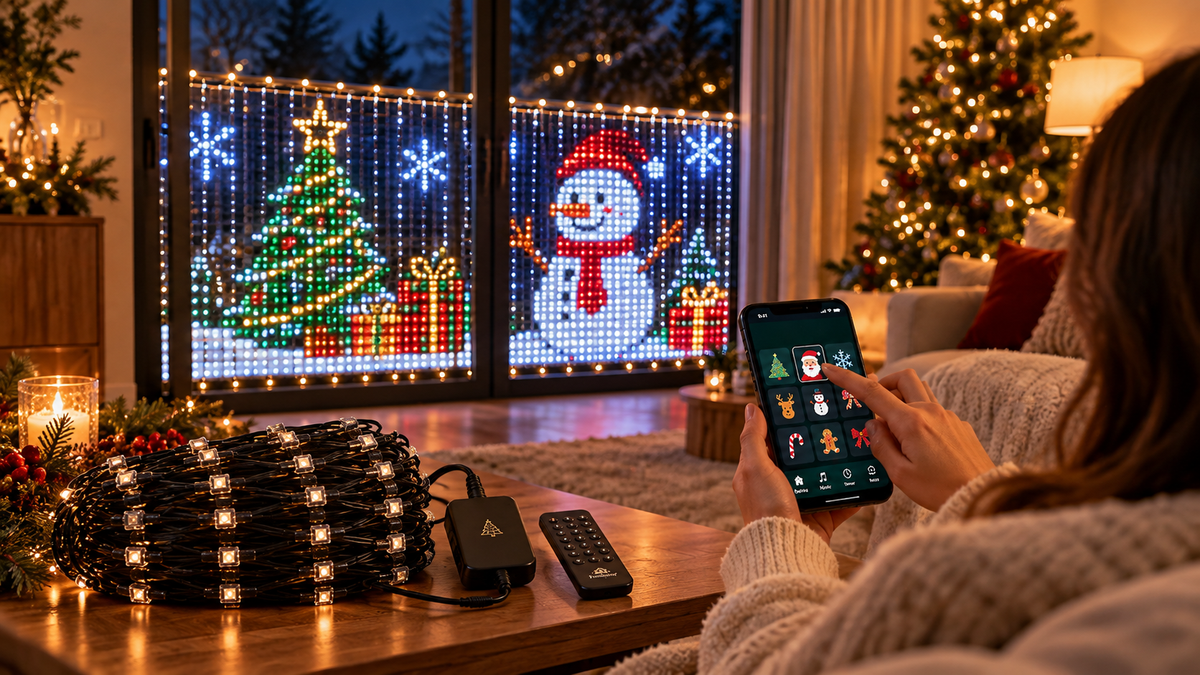
- The Static Mistake almost every house on your street makes (and why the eye is built to ignore it)
- What the people who build the famous drive-through light shows quietly switched to over a decade ago
- Why it stayed out of reach for a normal family until about two Christmases ago
- The "screen vs. strands" question Greg asked over the fence, and why the answer matters in daylight
- The 20-minute install that replaced his ladder weekend, and the one placement rule that makes or breaks it
Greg P. kept his Christmases on the top shelf of the garage.
Four plastic tubs. Icicle lights with one dead section he never found. Two boxes of multicolor C9s. A net light that tangled itself in storage. A reel of warm white he bought in a January clearance aisle and never opened. Zip ties, clips, a broken timer, a working timer, and a roll of electrical tape for the stuff that stopped working halfway through the season.
Eleven Decembers. One ladder. Same house every time.
Every year I'd spend a Saturday on the ladder, come inside with numb hands, flip the switch, and it looked fine. Just fine. Like every other house on the street.Greg P., 47, Dayton, Ohio
If you've done the ladder weekend, you know the tubs. Maybe yours are in the attic. Maybe they're in the basement next to the water heater.
And you know what every light in those tubs was built to do.
Sit there.
Not one of them asked the obvious question.
What if the reason your house gets a polite nod instead of a stopped car has nothing to do with how many lights you hang, and everything to do with the fact that none of them move?
For Greg, the answer came from the house two doors down, a nine-year-old in socks on a frozen sidewalk, and one question over a fence. What the neighbor told him made him laugh. Three weeks later, there were two cars stopped in front of his house.
It's also something the people who design the big professional light shows figured out years ago. What they did about it, and why it took this long to fit in a box you can hang in twenty minutes, is why this article exists.
Who this is for. You decorate because you love it, or because your kids do, and you're tired of the result looking like a store display from 2009. You want the house people photograph. You do not want a weekend on a ladder, a computer science degree, or an electrician.
Who it's not for. If you're happy with a single strand of warm white and a wreath, you don't need this. Close the tab. Nothing in here is for that house.
Our house always felt a bit plain at Christmas. Now there's a glowing green tree with red ornaments on the side wall. People keep stopping on the street to take pictures.Jenna M., verified customer
Keep reading. Especially if your first reaction, like Greg's, is going to be "that's just a screen, that's cheating."
That reaction turns out to be the most interesting part of the story.
"She stopped running to the window"
Greg's daughter Ellie was four the first year she helped. She held the clips. She counted the bulbs. When the lights came on she screamed like it was fireworks.
By the time she was nine, she didn't come outside for the flip of the switch anymore. "Looks good, Dad," from the couch, without looking up from the tablet.
He didn't blame her. He'd walked the dog past forty houses that week and couldn't have told you which ones had lights up. They all did. They all looked the same. Warm white on the roofline. Maybe a net light on a bush. Maybe an inflatable that deflated by Tuesday.

He did what everyone does. He bought more. A second reel for the garage. Lights on the railing. A projector that threw blurry snowflakes on the siding and died before New Year's.
More lights, same nod from the neighbors, same "looks good, Dad."
I wasn't trying to win anything. I just wanted my kid to run outside again. That's all it was.Greg P.
The low point was the second Saturday of December. Greg came down the ladder, flipped the breaker, and looked at eleven years of work. It looked fine. Nobody noticed, including him.
Then Ellie ran past him in her socks.
The porch two doors down
She was standing on the frozen sidewalk in front of the Nguyens' house with her mouth open.
On their porch wall, a Christmas tree was sparkling. Not blinking. Sparkling, in a slow wave from the bottom to the star. Then it faded, and a red gift box appeared and its lid popped open and little lights spilled out. Then a snowfall. Then Santa, waving.
A car slowed down. Then a second one. A kid in the back seat had his face pressed to the glass.
Greg's first thought was the one you're probably having. They bought a TV screen and hung it on the porch. That's cheating.
So the next morning, he asked Dave Nguyen over the fence.
Dave laughed and walked him over. Up close, in daylight, there was no screen at all. Just a curtain of thin, clear strands hanging flat against the wall, each strand dotted with tiny bulbs, so close together they looked like a grid. You could see the siding right through it.
It's not a screen. It's strands of lights that know where they are. You pick the design on your phone and the lights do the rest.Dave Nguyen, Greg's neighbor
Greg went home and did what skeptics do. He typed "animated christmas light curtain" into Google, expecting a gimmick.
He found a whole world instead. The drive-through light shows. The houses that go viral every December. The forums where people have been doing this for fifteen years.
That's where the story stops being about Dave's porch and starts being about how the eye works.
Part 1: The Static Mistake almost every house makes
Here's what nobody in the seasonal aisle will tell you.
Your eye is not a camera. It's a motion detector with a camera attached. The part of your vision that covers the edges, the part that scans a street as you drive down it, is built almost entirely to catch one thing: movement. Shape and color come after. Movement comes first.
It's why you notice a squirrel on a fence from across the yard and miss the fence. It's why a single flickering bulb drives you crazy and a thousand steady ones fade into the background.
Now think about what a string light does.
It turns on. It sits there. It's the same at 6 p.m. as it is at 10. It's the same on December 1st as it is on the 24th. By the second week, your brain has filed it under "wall" and stopped reporting it.
You've been hanging more and more of something your neighbors are built not to see.
Blinking doesn't fix it. A blink is a light turning on and off, over and over. The eye catches it once, then files it with the rest. What the eye can't file is a picture that changes: a tree sparkling in a wave, a box opening, snow falling. That's not a light turning on. That's a scene. It never becomes "wall."
This is the Static Mistake. And it isn't your fault.
The seasonal aisle runs on one idea: more lights, more wow. Bigger box, longer strand, brighter bulb. Nobody in that aisle makes money telling you the problem isn't how many lights you hang. It's that they don't do anything once they're up.
The people who build light shows for a living dropped that idea years ago. They even have a word for what they use instead: pixels.
Part 2: What the professional shows figured out
If you've ever driven through one of those big drive-through Christmas light parks, or watched a viral video of a house synced to music, you've seen pixels.
A pixel light is a bulb that can be any color, on its own, independent of the bulb next to it. Line enough of them up in a grid and you're not hanging lights anymore. You're hanging a canvas. A tree can grow on it. A gift can open. Snow can fall. Santa can wave.
Professional display builders switched to this more than a decade ago, for exactly the reason in Part 1. A static display, no matter how big, stops working on the eye. A moving one never does.
So why isn't every house on your street doing it?
Greg found out the hard way. He spent two evenings on the hobbyist forums and came back with a list:
- A dedicated controller box, often more than one
- Separate power supplies, run outdoors, waterproofed by hand
- Mapping software on a laptop, where you tell every single bulb where it lives on the wall
- Weeks of design work, per animation
- And a budget that, in his words, "looked like a used car"
It worked. It just wasn't for normal people. It was for the guy in every town who starts in August and makes the local news.

Then, about two Christmases ago, something changed.
Someone took the whole stack, the controller, the mapping, the animations, and built it into one curtain. The bulbs already know where they are. The controller is the size of a deck of cards and plugs into the curtain. The "software" is an app on your phone with a library of designs already made.

Everything Greg's forum guys built in their garages over a decade, hanging from a few hooks.
That's what was on Dave's porch.
Part 3: Why strands beat a screen
Which brings us back to Greg's first reaction, and probably yours.
Why not just hang a screen? A TV on the porch would move too.
Three reasons, and the third one is the one that matters.
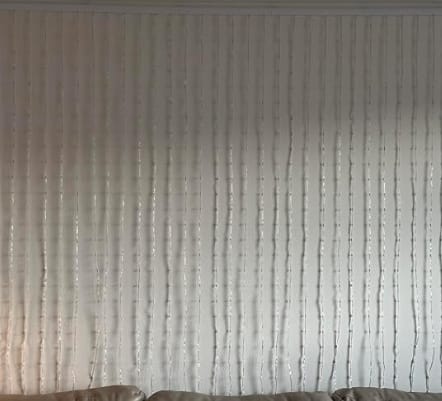
First, a screen is a rectangle of black during the day. Fourteen hours of a dark slab on your porch for one hour of magic. A curtain of thin, clear strands all but vanishes in daylight. One customer sent a photo of his, hung above the sofa with everything off, and you have to look twice to find it.
Second, a screen throws light at you. Pixel bulbs are the light. Each one is a tiny glowing point, so from across the street the tree reads as a tree made of lights, not a video of one. That's the difference between "they hung a TV" and "how did they do that?"
Third, and this is the part that surprised Greg: the strands are what make the picture sharp.
It's the spacing. On a cheap "animated" light set, the bulbs are far apart and the designs come out as a blur of random dots. On a curtain built for this, the strands hang close together, in a tight grid, so a Santa hat has a pom-pom and a tree has a star you can actually see from the sidewalk.
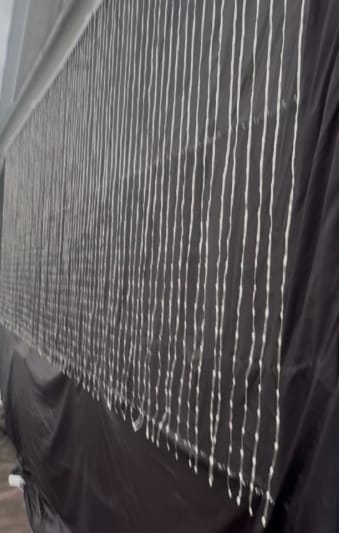
Here's the curtain hung up and still turned off, wanted to show how close together the strands are. Spaced this tight is why the designs come out so sharp instead of looking like random dots once it's on.Michael M., verified customer
So no, it's not a screen. And no, it's not "just lights."
It's small, thin and see-through because of how it works. Not in spite of it.
Greg's porch test (you can run it too)
He ordered one, laid it out on the dining table first like the box said, and plugged in the controller. The whole bundle lit up red. Then he paired the app, tapped a tree, and watched it sparkle on the tablecloth.
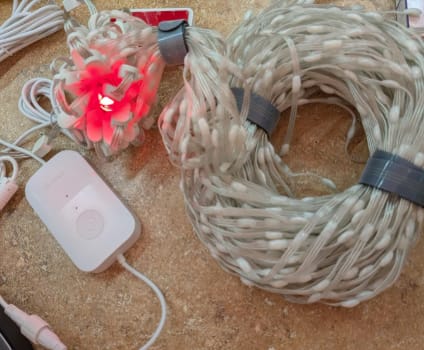
Ellie, from the doorway: "Is that ours?"
The next afternoon he hung it on the porch wall. Not on a ladder. Standing on the porch, with the hooks that came in the box. Twenty-two minutes, including the part where he went back inside for a pencil.
He set the timer for sunset. He went in for dinner. At 5:40 the porch lit up on its own, and his daughter was already outside in her socks.
That Saturday, two cars stopped. One of them backed up.
The tubs are still on the shelf. I didn't hang a single string light this year. My wife asked if I was feeling okay.Greg P.
One detail he left out the first time we talked: it wasn't the first "smart" light set he looked at.
Why most "animated" lights on the shelf won't do this
Here's where most people quit.
Search for "smart Christmas lights" and you get two kinds of results. The first is a plain string light that can change color. Red, then green, then blue. The whole string at once. That's a mood light, not a picture.
The second is a cheap curtain with bulbs spaced so far apart that "Merry Christmas" comes out looking like a broken scoreboard.
So Greg did what a guy who reads forums for two nights does. He wrote a spec sheet.
A curtain that does this one job needs five things:
- Every bulb on its own. Not a string that changes color together. Each pixel independent, so a scene can move across the grid. If the box says "16 colors," it's a mood light.
- Tight strand spacing. The strands are the resolution. Far apart, you get dots. Close together, you get a Santa hat with a pom-pom.
- Thin, clear strands. Dark cable on a light wall is a mess at noon. Clear strands disappear until dark.
- Designs already made, in the app. The forum guys spend weeks per animation. You should be tapping a tree, not drawing one. Bonus if you can draw your own when you feel like it.
- A timer that lives on the device. Sunset on, bedtime off, every night, without you. A display you have to remember is a display that's off half the season.
He bought two that failed the list. One had bulbs you could park a car between. One needed the phone within arm's reach to stay connected.
The one that stayed on his porch is called MerryPixels™ from Trenova.

MerryPixels is built around one idea, the same idea the professional shows run on: every bulb is a pixel. A grid of them, on thin clear strands, spaced tight. A controller that already knows where each one is. An app with 144+ designs ready to tap, and a canvas to draw your own.
That's the whole product. That's the point.
What you get, and what the first season looks like
What it is. A smart pixel curtain with three parts, each doing one job:
- The curtain. Thin, clear strands with individually controlled pixel bulbs, spaced tight so designs come out sharp. Made for windows, balconies, porch walls, garage doors, patios. Indoor and outdoor.
- The controller. About the size of a deck of cards. Plugs into the curtain and the outlet. Holds the timer, so the display runs whether or not your phone is nearby.
- The app. 144+ festive animations and effects. Christmas trees, gift boxes, snowfall, Santa, the Grinch, candy canes, messages, patterns. Change brightness, speed, colors. Draw and save your own. Set the schedule once. Sync multiple curtains for a bigger wall.
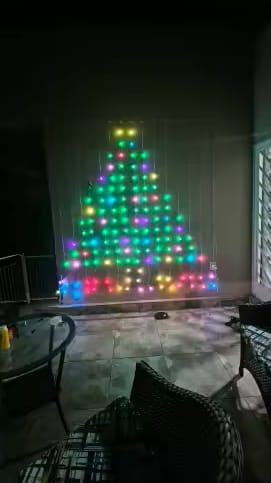
Hung it on the back patio wall and the multicolor tree with the little yellow star on top is the best thing we've done for Christmas out here. We've been sitting outside with hot chocolate every night just watching it. Picked the tree in the app in about a minute.Kelsey C., verified customer
What the first season looks like.
- TodayIt arrives. You lay it on the table, plug in the controller, pair the app, tap a tree. Your kid asks if it's yours.
- This weekendYou hang it. Hooks are in the box. Twenty minutes, standing up. You set the timer for sunset.
- Week oneYou run the sidewalk test. Walk to the street at 7 p.m. Count the cars that slow down. Switch the design from the couch for the first time.
- The rest of DecemberSnowflakes on cold nights. Santa on the 24th. Your kids spend an hour scrolling the designs. You never touch a ladder.
- January and afterHearts in February. The flag in July. Orange and purple in October. It rolls up smaller than one of your old tubs.
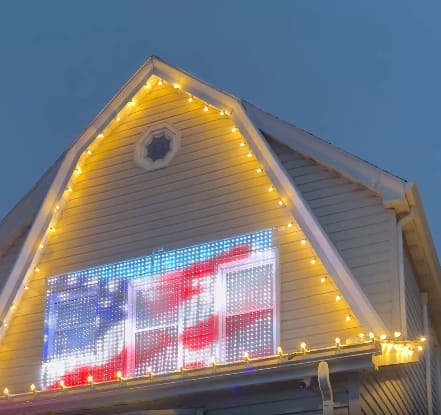
Who it's for. Families who decorate for the kids. People with a porch, a balcony, a big front window or a blank garage wall that's been "fine" for too long. Apartment dwellers with no yard who still want the street to notice. Anyone who has ever said "next year I'll do something cool" and then hung the same icicle lights.
What people who already hung it say
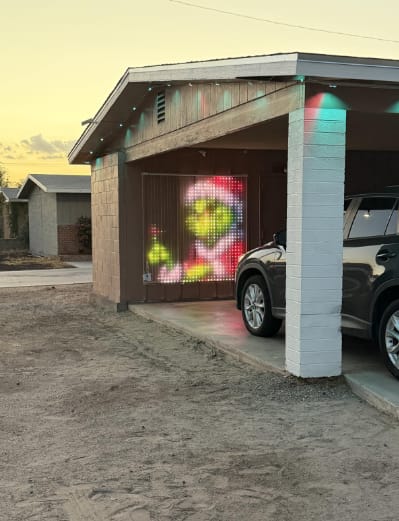
Picked it, set the timer, never touched it again
"The Grinch on our carport wall is the clear winner in this house. Picked it in the app, set the timer for sunset, and haven't touched it since. Neighbors keep slowing down to look."
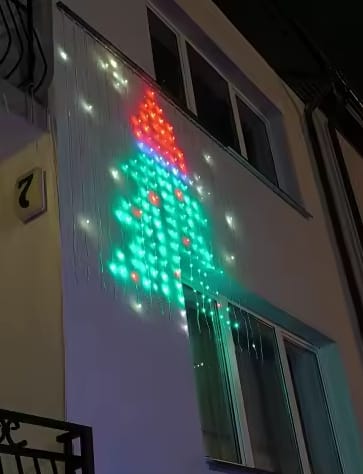
No yard, still stops people on the street
"We don't have a yard, just the side of the building, so I hung the curtain next to our windows. The tree comes through really clear from the street and the little white sparkles around it are my favorite part. Took about twenty minutes to put up."
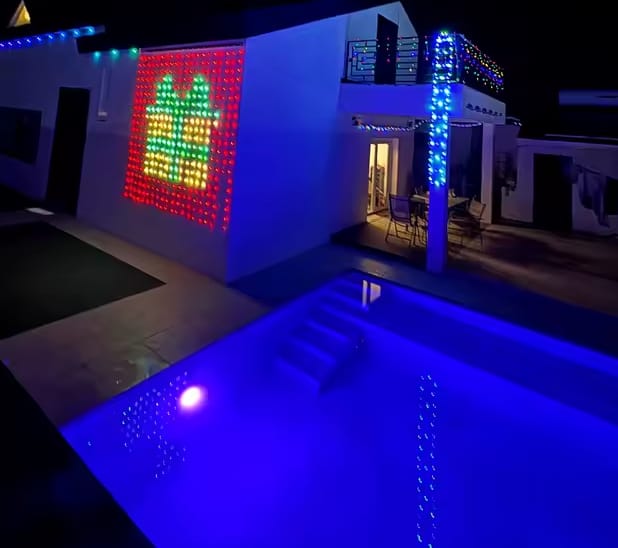
The neighbors walked over to see it up close
"Put the curtain on the wall next to our pool and the gift box animation looks incredible at night. The red, green and yellow reflect all over the water. My neighbors walked over just to see it up close."
I'm not techy and it took a few taps
"I was nervous about the app part because I'm not very techy. It was a few taps to pair it and a few more to pick a design. I figured out the brightness and the timer on my own too."
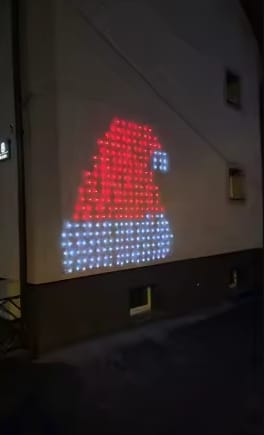
You can even see the pom-pom
"Santa hat on the side wall of our house. Every little pixel is crisp, you can even see the pom-pom, and it looks great from across the street. I rotate it with the snowflakes depending on the night."
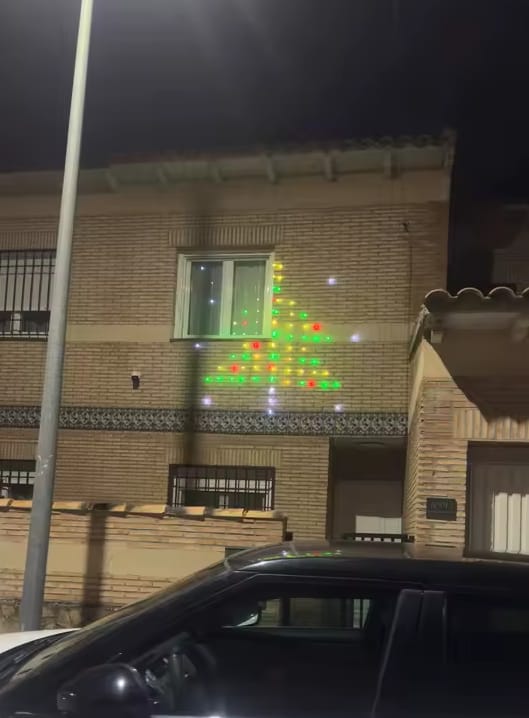
Reads clearly, but pick your wall
"The tree reads clearly even on our brick wall, but brick eats some of the brightness, so it looks smaller and dimmer than the ones I've seen on white walls. Still looks great from across the street and the app is super easy."
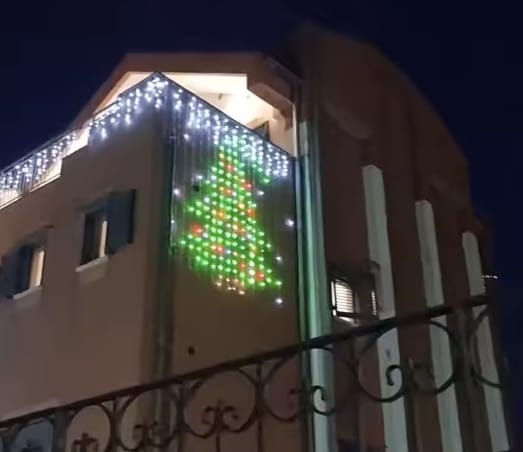
What's in the box. The curtain, the controller, the mounting hooks and accessories, and the manual with the app pairing steps. Greg's whole install came out of one box. No ladder in it.
What it should cost. The forum setup Greg priced out needed a controller, power supplies, software and a summer of weekends. His eleven years of tubs added up to a shelf of things that sit still. The projector lasted one season.
What it costs. One curtain, one evening. Two sizes, depending on your wall. The current price and today's offer are on the product page, and the Fall Sale won't run through December.
Choose your size
Tap a size and you go straight to the product page with today's offer applied. Medium fits a standard front window, a door or a balcony rail. Large fills a sliding door, a garage door or a porch wall almost edge to edge.
Doing two windows or a whole wall? Buy more, save more bundles are shown on the product page.
30-day hassle-free returns. Hang it, run the sidewalk test, let the kids scroll the designs. Not for your house? Send it back.
Before you decide: 30 days, and the kids get a vote
How ordering works. Tap a size. Pick a bundle if you want more than one. Check out. It ships fast, with tracking, from the U.S.
One honest thing. MerryPixels is a night product. In daylight it's a clear curtain of strands on the wall, which is the point, but it means the magic starts at dusk. And it reads best on a plain, lighter wall facing the street. Brick and dark stone soak up some brightness. Greg's porch wall is beige siding. Dave's is white.
The guarantee. Hang it for up to 30 days. Run the sidewalk test. Let your kids pick the design. If your street doesn't slow down, if nobody in your house ran outside in their socks, send it back. Hassle-free.
That's not a line buried in the fine print. It's the only honest way to sell something whose first impression is "that's just a screen."
What ships with every curtain:
- The curtain, controller and mounting kit. Everything Greg used. Nothing he had to buy.
- The design library. 144+ animations in the app on day one, plus the canvas to draw your own.
- The schedule. Set sunset-to-bedtime once. The controller remembers it, so the show runs whether you do or not.
- Support that answers. A real reply within 24 hours if the app pairing or the fit isn't right.
The math Greg did on the porch. He'd already spent eleven Decembers proving that hanging more of what sits still didn't work. One curtain to test the opposite idea, with 30 days to send it back if he was wrong, wasn't a hard decision. It was the first easy one in a long time.
Two ways this goes
You can close this tab. The tubs stay on the shelf until the first Saturday of December. You climb the ladder, you come in with numb hands, you flip the switch, and it looks fine. Your kid says "looks good" from the couch. The street gives it the nod it gives everyone. And here's the part nobody says: every year it's the same, the "next year I'll do something cool" gets a little quieter, until the kids are too old to run outside anyway.
Or a box shows up this week. You lay it on the table, tap a tree, and watch your kid's face. On Saturday you hang it in twenty minutes, standing up, and set the timer for sunset. Then you walk to the street at 7 p.m. and count. Then you know.
How to hang it (this is the part people get wrong)

The most common reason a pixel curtain "looks dim" is placement. People hang it in a window with the lights on inside, or on dark brick, or bunched in a corner where only the mailman sees it.
- Step 1: Test it on the table first. Plug in the controller, pair the app, tap a design. Make sure every strand lights before you go anywhere near a wall. Takes five minutes and saves a trip back down.
- Step 2: Pick the wall the street sees. Plain and light is best: siding, stucco, a painted garage door, the wall beside your front window. If your only option is brick, go Large and turn the brightness up.
- Step 3: Hang it flat and square. Use the included hooks. Strands straight down, evenly spaced, no bunching. The grid is the picture. A crooked grid is a crooked tree.
- Then: set the timer for sunset to bedtime, walk to the street, and count the cars. Get this right and you're running what the pros run. Get it wrong and you've hung a very nice light in a place nobody looks.
Note: the Fall Sale pricing on MerryPixels is how it's being introduced this season. It won't run through December. Check the current offer here.
Questions people ask before ordering
Is it hard to install?
No. The curtain comes with mounting hooks and accessories. Most people hang it in about 20 minutes on a window, balcony, porch wall, garage door or patio. Test it on a table first, then hang it flat.
Do I need to be good with apps?
You pair it once from your phone, then tap a design. Brightness, speed, colors and the timer are all in the same app. Customers who describe themselves as "not techy" set it up on their own.
Do the designs come included?
Yes. 144+ festive animations and effects are in the app from day one. You can also create and save your own designs, edit them, and choose display effects.
Can I use it outside?
Yes. MerryPixels is made for indoor and outdoor decorating. Follow the included installation and weather-use instructions for outdoor setups.
Does it turn on by itself?
Yes. Set a timer in the app and the controller runs the schedule every night, whether your phone is nearby or not.
Which size do I need?
Medium is 2 metres (6.6 ft) wide and fits a standard window, door or balcony. Large is 3 metres (9.8 ft) and fills a sliding door, garage door or porch wall. If you're unsure, customers consistently say they're glad they went bigger.
Can I connect more than one?
Yes. Multiple curtains can be synchronized to cover a larger wall or two windows side by side.
What if it's not right for my house?
You have 30 days. Hassle-free returns.
Choose your size
Tap a size and you go straight to the product page. Medium covers a window or a door. Large covers a sliding door, a garage door or a porch wall.